
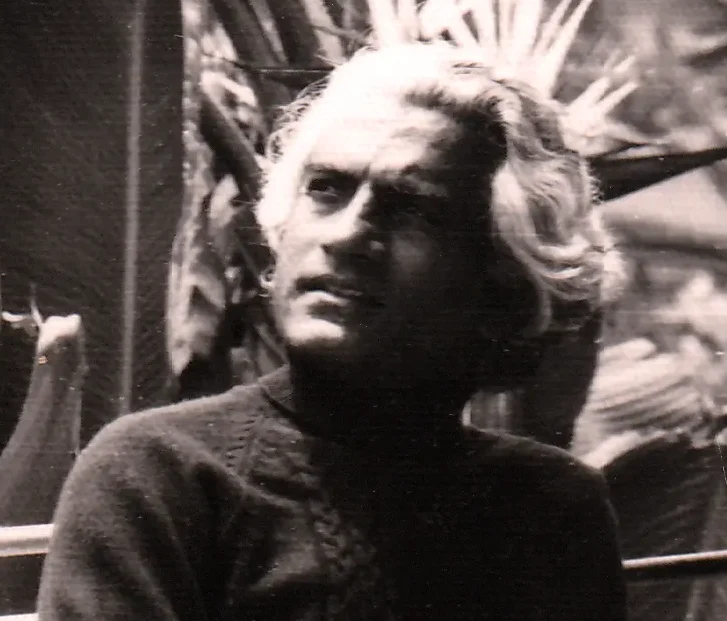
Vidya Bhushan’s life and work embody the extraordinary intersections of art, politics, and culture in twentieth-century India.
Vidya Bhushan was an only child born to his farmer parents in 1923 in the small village of Udgir, Maharashtra – erstwhile Hyderabad State. Disinterested in the dull academic classes of his rural school he filled his notebooks with drawings which baffled his rural teachers. His father died when he was just fourteen and so untethered from paternal control he ran loose with a coterie of politically charged hotheads who were involved with the Arya Samaj which was active in the struggle against the rule of the Nizam of Hyderabad and the gathering movement for India’s freedom from British rule.
Bhushan was amongst those activists who were sentenced to Bidar Jail for this rebellion in 1937-38 but were released ten months later with the intervention of Pandit Vinayak Rao Vidyalankar, prominent leader of Hyderabad State and Bar-at-Law. He then moved to Hyderabad to study art but as there was not yet an art school there he joined the Nutan Vidyalaya, Gulbarga, where S.N Alandkar conducted an Art Section affiliated to JJ School of Art, Bombay.
After passing the third year examinations, he was compelled to return to Hyderabad due to financial straits where he took a job as Drawing Teacher at Keshav Memorial School, established in 1940 by Vidyalankar as part of the Freedom Movement’s aspiration to educate Indian children. In 1941, The Hyderabad Art Society held an All India Art Exhibition and Bhushan participated with a charcoal self-portrait which won him the Society’s Gold Medal and brought him prominence. Shri LN Gupta, ICS who was the president of the Society and a philanthropist, sent him to JJ School of Art to complete his studies. He graduated with a Diploma in Painting from JJ School of Art, Bombay in 1944 with an Outstanding Student prize and the Lord Mayo prize for best works.
Back in Hyderabad, Bhushan struggled to earn a living as a painter and decided to join a film company in Bombay as Art Director but this too proved to be unrewarding and he returned in 1947 when he was commissioned to make murals in the Nizam Palace, (now Hyderabad House) New Delhi. In 1952 he joined the faculty of the College of Fine Arts and Architecture, Hyderabad ( now Jawaharlal Nehru University of Fine Arts & Architecture).
In 1952 he was deputed by the State Government and Archeological Department of Hyderabad to copy the Ajanta Murals for their archives and was the only artist to do so in the medium of egg tempera.
From 1954-55 he was a Government of India Cultural Scholar for post diploma in Mural and Painting at the Belgrade Academy of Art, Yugoslavia, at the atelier of the master artist Milo Milunovic, who founded the Belgrade Academy of Art in 1937. Bhushan’s early political activity as a freedom fighter gave him an added interest in Yugoslavia’s vibrant political/cultural milieu under Marshal Tito’s Socialist Federal Republic of Yugoslavia.
In 1957 he was awarded the President’s Gold Plaque, the Indian National Award and also a prize at the International Art Exhibition, Moscow. His portraits of political leaders Gandhi, Nehru, Sardar Patel, Abdul Kalam Azad, Indira Gandhi, Lal Bahadur Shastri and Rajiv Gandhi are in Parliament Hall and Telangana Assembly buildings. He has exhibited in India, Europe and the United States. His works are in several national and international collections.