
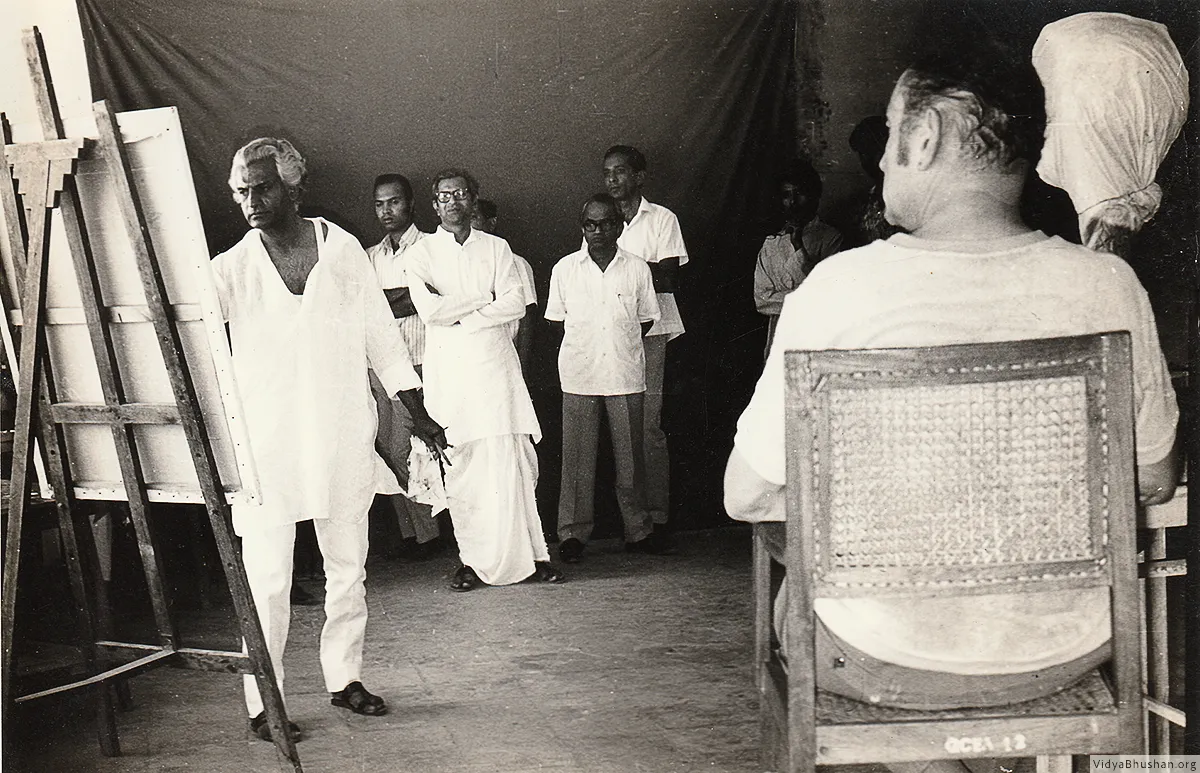
Artist Demonstrations
Vidya Bhushan and Soviet-Ukranian artist Bondarenko Nikolay Ignatievich whom he had known from his student days in Belgrade, are seen here doing demonstrations for the students at the College of Fine Arts, Hyderabad, around 1965-67. Bhushan did an oil on canvas and Bondarenko a sculptural head.

‘Demos’ as they were called were seen as an essential component of art training. The artist-teacher actively showed a student how to begin a composition for a portrait, still life, or landscape. Knowledge of colours, materials and mediums of art, and tools (pencil, charcoal, oil pigments, watercolour, etc) were imparted both theoretically and practically. The teacher necessarily had to be skilled in different mediums and techniques in order to impart learning to the students.
Much before ready stretchers and pre-primed canvases were available in the market, artists made their own from scratch. They learnt how to construct the wooden frame, how to stretch canvas and prepare its surface for painting. Raw canvas was primed with animal glue made by boiling animal hooves, bones and tendons to extract collagen which when cooled to room temperature became brittle. These could be bought very cheaply in the market in the form of flakes which were then diluted with water to form a liquid which was brushed onto the canvas in thin layers to stiffen and make the canvas non-permeable. ‘Demonstrations’ began from this stage.
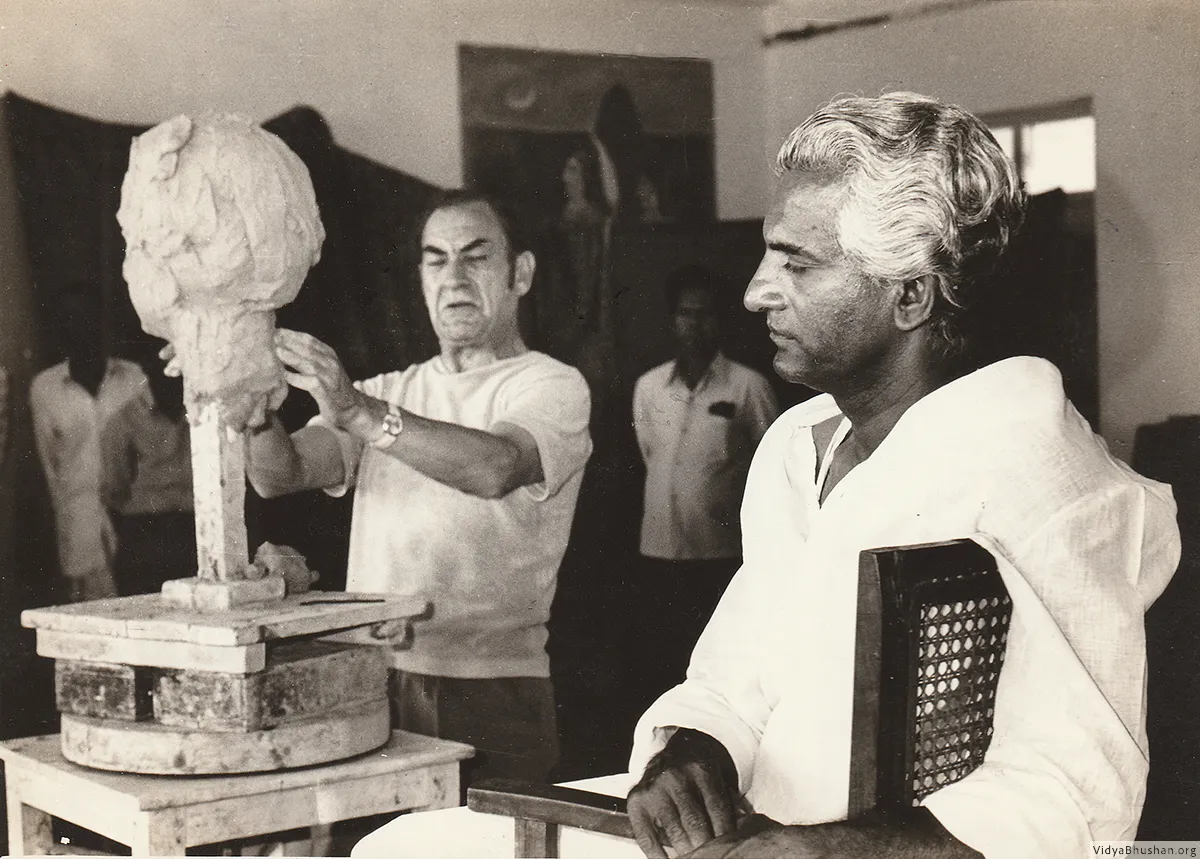
Initially, demonstrations were probably part of apprentice-style learning where students observed and emulated the artist/mentor. As art education moved into more formal classroom/studios the demonstration became part of a structured approach that included theory and analysis. The artist-teacher worked on a composition while students watched, showing them how to lay out a palette, mix and apply pigments while transforming the three-dimensional subject into two-dimensional pictorial space.
Senior students like Laxma Goud, Kavita Deuskar and the late Suryaprakash recall how Bhushan regularly gave demonstrations of figure studies, still life or landscape while they watched in pin-drop silence. The very act of rendering an object/form as it transforms under the effect of light and by the surrounding space was a critical learning experience.
‘Demos’ are by far no longer done in art schools in India. The teacher as a practicing artist, witnessed by students in the act of making art in the classroom/studio, is a teaching practice that rarely exists today.